The Copy-Clone Crisis: How AI-Generated Web Content Is Making UK Businesses Invisible

Photo: Colin Park , CC BY-SA 2.0, via Wikimedia Commons
Open five websites for independent financial advisers in the East Midlands. Read the homepage copy on each one. Then try to remember which was which.
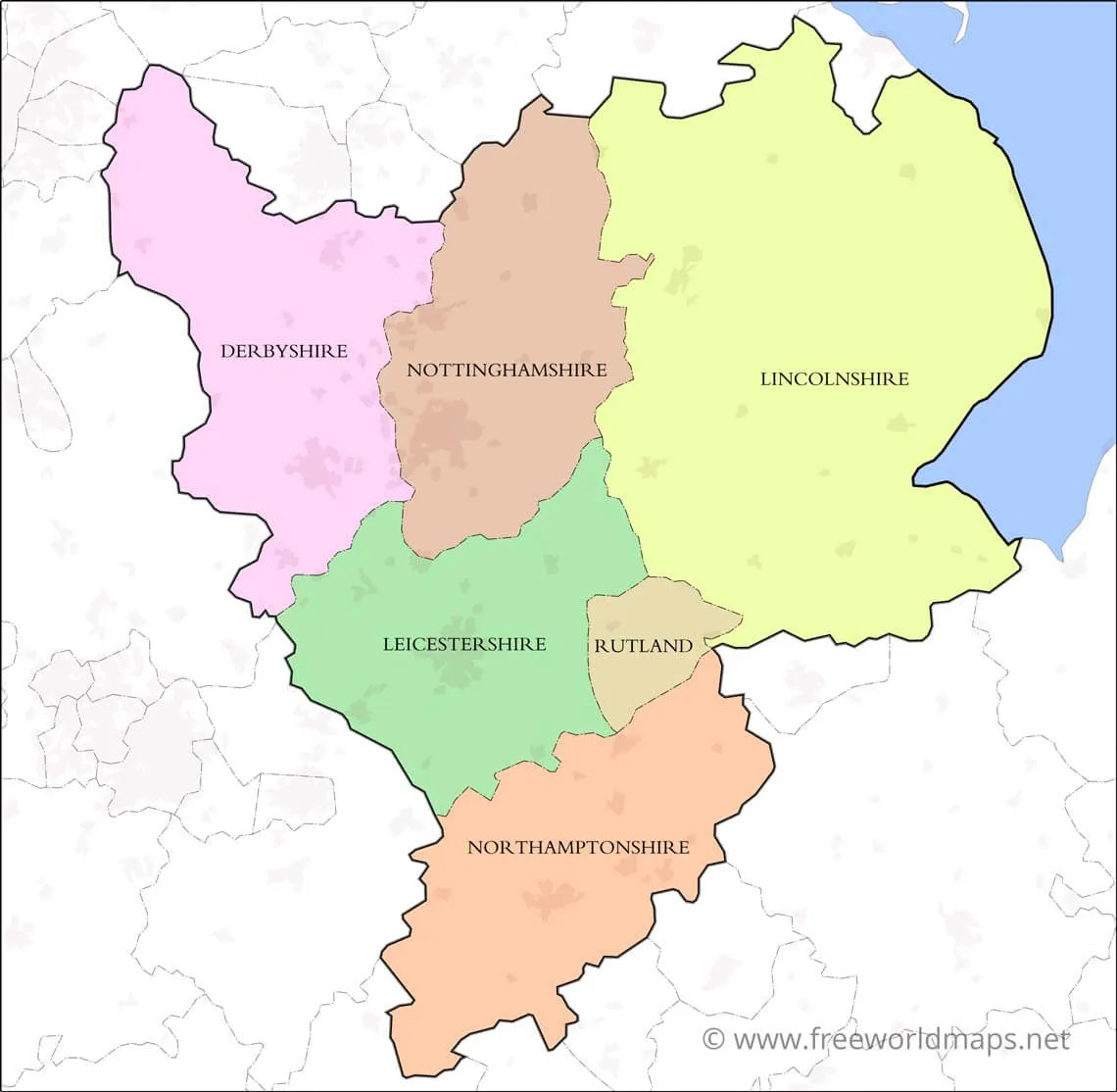 Photo: East Midlands, via www.freeworldmaps.net
Chances are, you can't — because they're essentially the same. The same reassuring opening about 'your financial future.' The same bullet points about 'tailored advice' and 'regulated expertise.' The same closing call to action inviting you to 'book a free consultation today.' Even the sentence rhythm feels identical, that particular cadence of confident-but-cautious that AI writing tools have made their default register.
This isn't a coincidence. It's the predictable consequence of thousands of UK small businesses turning to the same handful of AI content tools to populate their websites quickly and cheaply — and those tools drawing from the same vast pool of existing web copy to generate something that reads as plausible, professional, and utterly indistinguishable from the competition.
Welcome to the copy-clone crisis.
How We Got Here
The appeal of AI-generated web copy is easy to understand. Writing is hard. Good writing is expensive. A tool that produces a 500-word service page in 30 seconds for a fraction of the cost of a professional copywriter is genuinely attractive to a cash-conscious SME trying to get a new site live before the quarter ends.
And to be fair, the output isn't bad — in the narrow sense that it's grammatically correct, professionally toned, and structurally coherent. For businesses that previously had no copy at all, or whose old site read like it was written by someone who'd rather be anywhere else, AI-generated content can feel like a genuine upgrade.
The problem isn't the quality of any individual piece. It's the cumulative effect when an entire sector adopts the same tools, prompts the same outputs, and publishes the same voice at scale.
The Sectors Hit Hardest
Some industries are more vulnerable to this homogenisation than others — typically those where the service offering is inherently similar across providers, and where businesses have historically struggled to articulate meaningful differentiation.
Financial services is perhaps the most acute example. IFAs, mortgage brokers, and wealth management firms across the UK are operating in a heavily regulated environment where the language of compliance creates a natural ceiling on creativity. Add AI to that mix and you get copy that's not just similar — it's almost legally identical in its careful, caveated phrasing.
Legal services follows a similar pattern. Solicitors and legal consultancies, particularly in areas like conveyancing, employment law, and personal injury, are producing web copy that reads as though it came from the same template — because, effectively, it did.
Trades and home services — plumbers, electricians, builders, roofers — are seeing the same thing at a local level. AI-generated content about 'fully qualified professionals serving [location]' is flooding local search results, making it almost impossible for genuine specialists to stand out purely on the basis of their web copy.
What This Is Doing to Search Rankings
Here's where the commercial consequences become very real.
Google's search algorithms have grown increasingly sophisticated at identifying and deprioritising content that lacks originality, specificity, and what the company calls 'helpful content' — material that demonstrates genuine expertise and adds real value to the reader beyond what's already widely available.
The Helpful Content updates rolled out over the past few years were explicitly designed to address exactly this kind of mass-produced, formulaic web copy. Sites that rely heavily on AI-generated content without meaningful human editing and brand-specific context are increasingly finding themselves pushed down search rankings in favour of pages that demonstrate real depth and authenticity.
For a local IFA in Sheffield or a roofing firm in Cardiff, losing ground on local search isn't an abstract concern. It's the difference between a steady stream of inbound enquiries and an over-reliance on paid advertising just to stay visible.
There's also a secondary effect worth noting: when all your competitors rank for the same terms with the same copy, click-through rates drop across the board. Users scanning a search results page of near-identical listings become fatigued and either refine their search, click the paid ads, or go back to a recommendation from someone they trust. Nobody wins.
The Brand Distinction Problem
Beyond SEO, there's a deeper issue that's harder to quantify but arguably more damaging in the long run.
Brand trust is built on distinctiveness. When a potential customer lands on your website, they're making a rapid, largely subconscious assessment of whether you're the kind of business they want to work with. That assessment is informed by everything — the design, the imagery, the tone of voice, the specific language you use to describe what you do and who you do it for.
AI-generated copy, by its nature, optimises for the middle. It produces content that is broadly acceptable to a broad audience — which means it's rarely compelling to any specific audience. It doesn't capture the particular way a family-run accountancy firm in Inverness thinks about its clients. It can't convey the quiet confidence of a solicitor who's been handling agricultural property disputes in the Welsh borders for 25 years. It doesn't know that your plumbing firm is the one people call first because you once stayed until midnight to fix a burst pipe for an elderly couple who couldn't reach anyone else.
Those stories are your brand. And no AI tool — not yet, not without significant human intervention — can generate them from a prompt.
What the Smart Money Is Doing Instead
The businesses and agencies responding most effectively to this crisis aren't rejecting AI outright. They're using it strategically — as a structural tool for drafts, research, and ideation — while investing in human expertise for the work that actually differentiates.
That means working with copywriters who conduct proper discovery: who speak to the business owner, understand the customer, dig into the specific problems the service solves, and find the language that's genuinely native to the brand. It means building content strategies around proprietary insight — case studies, client outcomes, specific methodologies — that competitors simply can't replicate.
It also means treating web copy as a living asset rather than a one-off production. Brands that regularly update their content with fresh, specific, human-authored material are consistently outperforming those that set and forget — regardless of whether the original copy was AI-assisted or not.
The Competitive Advantage Is Clear
Here's the counterintuitive reality of the current moment: the mass adoption of AI-generated web copy has made genuine human storytelling more valuable, not less.
In a landscape where your competitors all sound the same, sounding like yourself is a meaningful competitive advantage. Specificity cuts through. Personality converts. A homepage that reads like a real person wrote it — someone who actually understands the reader's problem and has a distinct point of view about how to solve it — outperforms a thousand competent-but-forgettable AI outputs.
The businesses that recognise this now, and invest accordingly, will be the ones building durable brand equity while everyone else is fighting over the same undifferentiated middle ground.
The copy-clone crisis is real. But for the businesses willing to do the harder, more human work of crafting a genuine digital voice, it's also an opportunity.