Tear Up the Brief: Why the Smartest UK Agencies Are Replacing Documents With Dialogue
For decades, the written brief was sacred. A client filled it in, an agency read it, and work began. Simple, right?
Not really. Anyone who's spent time in the UK digital industry knows the reality: briefs arrive half-finished, padded with marketing speak, or so rigidly defined that they accidentally close off the best solutions before a single conversation has happened. The document becomes a wall, not a window.
A growing number of UK agencies have had enough. They're scrapping the traditional brief entirely — or at least demoting it — in favour of something messier, more human, and considerably more effective: the discovery workshop.
What's Wrong With the Brief as We Know It
The written brief made sense in an era when agency relationships were transactional and time was billed in neat units. A client articulated what they wanted. An agency priced it up. Work began. Everyone knew where they stood.
The problem is that most clients — particularly SME owners and marketing managers without deep digital experience — don't actually know what they want at the outset. They know what problem they're trying to solve. They know what outcome they're hoping for. But translating that into a coherent written specification requires a level of digital fluency that most people simply don't have, and shouldn't be expected to have.
So briefs get filled in with assumptions dressed as requirements. 'We need a website redesign' often actually means 'we're losing leads and we don't know why.' 'We want better UX' sometimes translates to 'our checkout is broken and nobody's told us.' The document captures the symptom. The real problem stays buried.
For agencies, this creates a familiar trap. You build what was asked for. The client is underwhelmed. Everyone wonders what went wrong. The brief said one thing; the business needed another.
Enter the Discovery Workshop
The shift happening across leading UK studios isn't just a change in process — it's a change in philosophy. Rather than asking clients to define the solution upfront, these agencies are investing time at the start of a relationship to properly understand the problem.
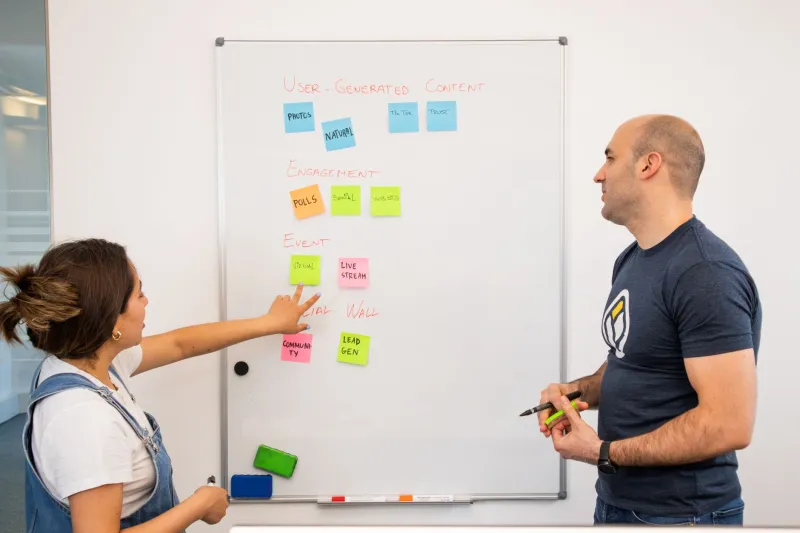
Discovery workshops vary in format, but the best ones share common characteristics. They're facilitated conversations, not presentations. They bring together stakeholders from across the client business — not just marketing, but sales, operations, sometimes customer service. They use structured exercises to surface assumptions, align on goals, and identify constraints that would never appear in a written brief.
A Bristol-based digital studio overhauled their onboarding process two years ago after noticing that projects with detailed upfront briefs were no more likely to succeed than those with minimal documentation. What predicted success, they found, was the quality of the initial conversation.
They now run a two-day paid discovery process before any project formally begins. Clients who go through it report feeling genuinely heard for the first time in an agency relationship. The studio reports fewer scope changes, fewer late-stage pivots, and significantly higher client satisfaction scores.
What Discovery Actually Looks Like
For businesses used to filling in a form and waiting for a proposal, the discovery model can feel disorienting at first. Here's what a well-run discovery process typically involves.
Stakeholder mapping. Before the room fills up, good facilitators identify who actually has a stake in the outcome. Not just the person who signed the contract, but the people who will use the system, the team who'll maintain it, and — crucially — representatives of the customers being served.
Problem framing. Early exercises focus on articulating the problem as clearly as possible, without jumping to solutions. 'We need a new website' gets interrogated until the underlying business challenge is visible. This is often where the most valuable insights emerge.
Assumption surfacing. Every project starts with assumptions — about users, about competitors, about what will and won't work. Discovery workshops make these explicit, so they can be tested rather than baked silently into the project.
Priority alignment. Different stakeholders almost always have different priorities. A workshop creates space to surface these tensions and resolve them before they become expensive mid-project disagreements.
Outcome definition. What does success actually look like? Not in vague terms ('a better website') but in measurable ones ('a 20% increase in qualified enquiries within six months'). Workshops are far better at producing this kind of clarity than written briefs.
The Brief Doesn't Disappear — It Evolves
It's worth being clear: the death of the brief doesn't mean the death of documentation. The best agencies aren't choosing between conversations and documents — they're using conversation to produce better documents.
What emerges from a well-run discovery process is typically a project strategy document that's richer, more accurate, and more genuinely useful than any upfront brief could have been. It reflects what was actually said in the room, not what someone guessed they should write down before the relationship had properly started.
For businesses commissioning digital work, this shift has practical implications. If your current agency relationship still begins with a blank form, it might be worth asking whether there's a better way to start. A paid discovery phase isn't an extra cost — it's insurance against the far greater expense of building the wrong thing.
Making It Work Without an Agency
You don't need to be working with a progressive studio to adopt the principles of discovery. Internal digital projects — whether you're briefing an in-house developer or refreshing your own marketing strategy — benefit from exactly the same approach.
Set aside time before any project begins to bring the right people into a room (or a video call). Ask the uncomfortable questions. What problem are we actually solving? Who is this for, really? What would success look like in six months? What are we assuming that might not be true?
The answers will almost certainly change the shape of the project. That's not a complication — that's the point. Better questions at the start mean fewer expensive surprises at the end.
The brief isn't dead. But the era of treating it as a substitute for genuine conversation? That's very much over.